
next up

lightning lesson Maven

Building Your Agent Indexing System

with Doug Turnbull

A coding agent reads more of your repository in an afternoon than a new hire reads in a month. It writes down every file it opened and every approach it abandoned, and then the session closes and all of it goes in the bin. What survives is usually run counts and token spend, which is enough to bill against and too thin to engineer against. This talk builds the archive instead.

recorded

lightning lesson Maven

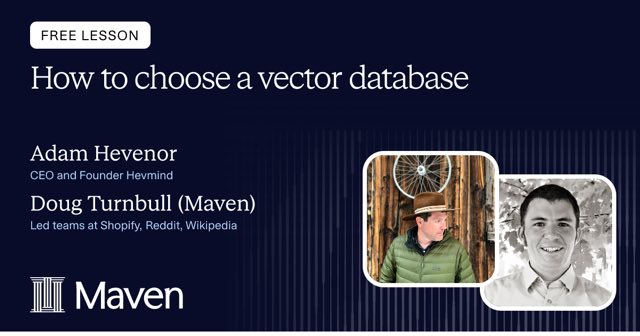
How to Choose a Vector Database

with Doug Turnbull & Trey Grainger

Vendor calculators quote a month you will never have. I price a 100 GB corpus end to end — the writes your index actually creates, every re-index after that, and the build-vs-buy line on one basis — then get to what really decides it: the search system you already run, the credits you already have, and how fast your data grows.

podcast Open Source Ready, ep. 27

Rethinking AI Evals

with Brian Douglas & John McBride

What an eval actually is, why the experiment phase deserves tooling of its own rather than borrowing the production-monitoring stack, and why downgrading to a smaller model often beats the big one at simply handing off to a tool. Plus MCP adoption, Claude Skills, and the economics underneath AI tooling.

webinar Aerospike

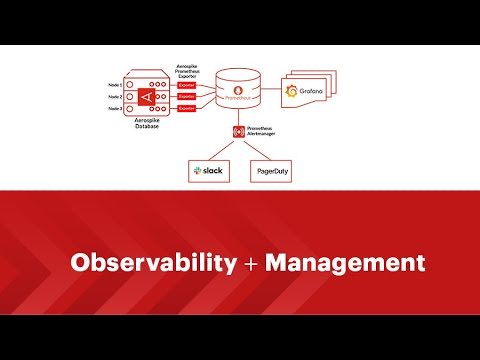
Observability and Management: Updates in Aerospike

with Steve Tuohy

The observability stack under a distributed database — Prometheus exporter, time series store, Grafana, Alert Manager — and then the operator's side of it: multi-tenant quotas so teams can share a cluster, cross-datacenter replication for failover, and reading a latency dashboard when writes start backing up.

conference talk Cloud Foundry Summit Europe, Basel

Introducing Log Cache — a RESTful interface for observing distributed systems

Log Cache put a queryable window over the platform's log and metric stream behind a REST API, so you could ask what just happened without standing up a full logging pipeline in advance to catch it.

conference talk Cloud Foundry Summit Europe, Basel

Defining Service Level Objectives for Loggregator

Applying SRE practice to the logging subsystem itself: which indicators are worth measuring for log delivery, how to set an objective against them, and what changes about running the system once you have a number you have to defend.

conference talk Cloud Foundry Summit Silicon Valley

Addressing Delivery Reliability in Loggregator

How Loggregator's architecture changed to make log delivery dependable — where the network protocol was losing messages, how buffers handle backpressure, and what service discovery had to do with any of it.

Start typing to search.